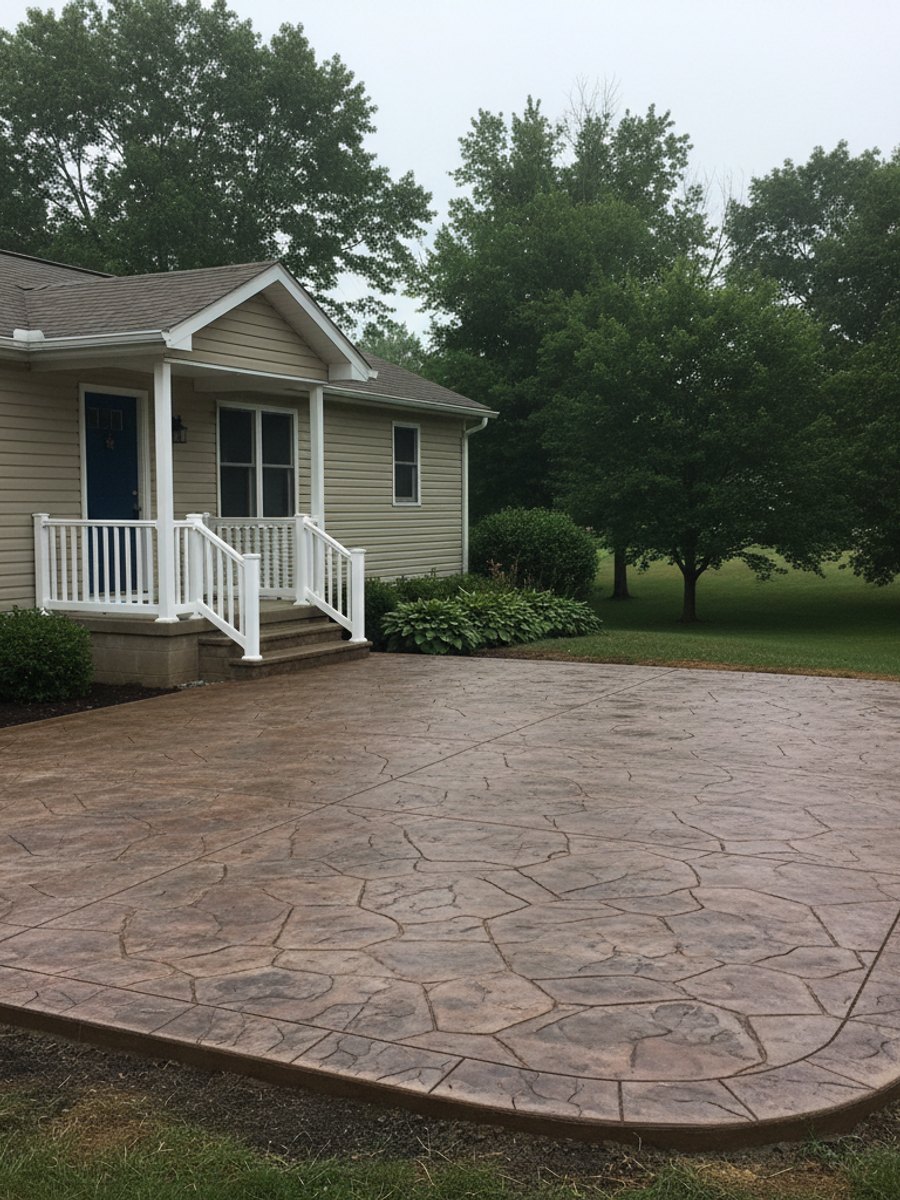
Anybody with a mixer truck's phone number can call themselves a concrete contractor. The work that separates a slab that lasts thirty years from one that's cracked and heaving by year five happens before the truck ever shows up, and most homeowners never see that part. Here's what to actually look at.
What's happening under the slab matters more than what's on top
York County sits on a mix of shale-derived clay and silty clay loam, with some areas closer to limestone and a little karst activity thrown in depending on where you are. Clay holds water, then shrinks hard when it dries out. That movement under a slab is the number one reason driveways and patios crack or settle unevenly a few years in. A contractor who knows the ground here will excavate down past the topsoil, put down 4 to 6 inches of compacted crushed stone as a base, and compact it in lifts, not just dump it and drive the truck over it once. Ask what the base prep involves. If the answer is vague, that's a problem.
On older lots in the city, in neighborhoods like the Avenues or around North York, you're often dealing with fill from decades of additions, old walkways, buried debris, sometimes old coal ash. Newer subdivisions out in Springettsbury Township or Spring Garden Township were mostly farm fields before they were built out, and farm fields have their own issues, mainly inconsistent soil density where old field drainage or plow lines sit. Neither is automatically worse. Both need someone who actually digs a test hole and looks before quoting a price over the phone.
What a real bid should include
A written estimate should tell you the slab thickness. Standard is 4 inches for a patio, walkway, or a driveway that only ever sees cars. If you're parking a truck, an RV, or a dumpster on it, you want 5 to 6 inches, sometimes with reinforcement bumped up. It should tell you whether you're getting welded wire mesh or rebar, and if it's rebar, what size and spacing, commonly #3 or #4 bar on 18 to 24 inch centers. Mesh has its place but it's easy to install wrong, sitting on the ground instead of held up in the middle of the pour where it actually does something.
It should name the concrete mix, usually 3,500 to 4,000 PSI for residential flatwork here, and it should be air-entrained. Air entrainment puts microscopic air bubbles into the mix so it can handle freezing water expanding inside it without spalling apart. York gets somewhere around 30 to 40 freeze-thaw cycles a winter, not the brutal deep freeze of further north, but enough repeated freezing and thawing that non air-entrained concrete on an exterior slab is asking for surface flaking within a few winters.
Last, the bid should say where the control joints go. Concrete is going to crack somewhere, that's not optional, the question is whether it cracks where you want it to. Joints are typically cut every 8 to 10 feet, and ideally within 24 hours of the pour, before the slab picks its own crack line. A contractor who doesn't mention joints at all either forgot to or doesn't think it's worth explaining, and neither is a good sign.
Permits, inspections, and why they're not a formality
Most municipalities in York County, whether it's a borough or a township, require a permit for a new slab tied to a structure, a footer, a retaining wall over a certain height, or anything involving a foundation. A stand-alone patio sometimes needs one and sometimes doesn't depending on size and where it sits relative to your property line, so it's worth checking with your specific township or borough rather than assuming. Setback rules vary block to block, especially in older rowhome sections where lots are narrow and property lines were drawn a century ago. HOAs are common in the newer developments out past the city and in some of the townships, and they sometimes have their own material or color rules on top of whatever the municipality wants.
Footers for anything load-bearing need to go below the frost line, which in this part of Pennsylvania runs around 30 to 36 inches. An inspector will want to see that depth before concrete gets poured, not after. A contractor who tells you permits and inspections aren't necessary for your project might be right, but they might also be telling you that because it's faster for them, not because it's actually true for your job.
Red flags worth walking away from
- A price that's dramatically lower than every other bid you got, with no explanation for why.
- Cash only, no written contract, no mention of a permit even where one is clearly required.
- No mention of soil or base prep at all, just a quote for pouring concrete.
- Pushing you to schedule a pour in the dead of summer heat without talking about how they'll manage the cure, or in December without talking about cold weather protection.
- Can't answer a direct question about mix strength, thickness, or joint spacing.
None of these alone means walk away immediately, but two or three together usually does.
Timing and weather in York
Spring here is wet, March through May, and a contractor pouring right after a heavy rain without checking the ground is compacted and dry enough is setting you up for problems later. Summer heat, especially through July and August, speeds up curing, which sounds good but actually risks surface cracking if the crew isn't keeping it damp or covered in the first days. Concrete needs about 24 to 48 hours before you can walk on it, roughly 7 days before a car should drive on it, and it keeps gaining strength for a full 28 days. Fall is usually the best window here, cooler temperatures, less rain than spring, still warm enough overnight for a proper cure.
A good contractor will talk you through all of this without being asked, because it's just how the job gets done right. If you're weighing quotes for a driveway, a patio, a repair, or a new foundation slab anywhere around York, take a look at Classic Concrete and ask us the same questions you'd ask anyone else. The answers should hold up.